


Famous swords in history and their enduring legends
Few objects in human history stir the imagination quite like a legendary sword. Whether locked behind museum glass or embedded in stone by myth, these blades sit at a fascinating crossroads where documented history and storytelling collide. Some were carried into real battles, stamped with the marks of master craftsmen, and passed through royal hands for centuries. Others exist only in epic poems and folklore, yet their cultural weight rivals anything with a verified provenance. This article walks through the most famous swords across cultures, examines what truly earns a blade legendary status, and explains why collectors, historians, and gamers keep coming back to these stories.
Table of Contents
- Choosing criteria: What makes a sword legendary?
- Joyeuse, Durandal, and Western epic swords
- Japanese treasures: Honjo Masamune, Kusanagi-no-Tsurugi, Dōjigiri
- Ancient Asian marvel: Sword of Goujian
- Comparing legendary swords: Features at a glance
- Expert perspective: Why sword legends endure—and what collectors overlook
- Explore and collect: Real and replica swords for enthusiasts
- Frequently asked questions
Key Takeaways
| Point | Details |
|---|---|
| History and myth intertwine | Many famous swords are celebrated as much for their stories as for their physical existence. |
| Cultural contrasts shape legends | Western, Japanese, and Chinese swords each emphasize unique values such as chivalry, craftsmanship, or preservation. |
| Replicas and games preserve legends | Modern collectors and gaming fans keep sword myths relevant through replicas and digital worlds. |
| Artifacts remain accessible | Museums and specialty retailers allow enthusiasts to view or acquire both legendary and historical swords. |
Choosing criteria: What makes a sword legendary?
Not every old blade earns a legendary reputation. The swords that rise above the rest typically check several boxes at once, and understanding those criteria makes every story on this list richer.
Historical evidence is the first filter. An artifact with a verified age, a traceable chain of ownership, and physical presence carries weight that pure legend cannot. Blades like Joyeuse and the Sword of Goujian have been studied by metallurgists, dated by historians, and placed in specific eras with confidence. That physical reality grounds the myth and gives collectors something tangible to connect with.
Mythic narrative is equally powerful. As famous swords blur history and myth, real artifacts like Joyeuse and Honjo Masamune gain legendary status through compelling stories, while purely mythical swords like Excalibur symbolize power and destiny without needing a physical form. The stories themselves become the artifact.
Cultural symbolism varies dramatically by region, which is part of what makes comparing these blades so rewarding. European swords often tie into Christian relics, chivalric codes, and royal ceremony. Japanese swords reflect Buddhist philosophy, warrior honor, and divine origin. Chinese swords can represent dynastic power and technological mastery. Each tradition assigns meaning differently.
Craftsmanship and materials round out the picture. A sword forged with techniques ahead of its time, using rare steel alloys or unique construction methods, earns respect from metallurgists and collectors alike. The artistry matters as much as the age.
Here is a quick overview of what drives legendary status:
- Verifiable historical age and provenance
- Connection to a famous ruler, warrior, or deity
- Mythic stories that amplify the blade’s importance
- Exceptional craftsmanship or unusual preservation
- Influence on art, gaming, literature, and collecting culture
Pro Tip: When evaluating sword replicas for your collection, look for pieces inspired by documented historical examples. A replica tied to a real legend, like the ones in our medieval swords collection, carries far more display value than a generic design.
Joyeuse, Durandal, and Western epic swords
Western legendary swords are deeply tied to the medieval world, Christian symbolism, and the idea of the warrior king who rules by divine right. Two swords stand out above the rest.
Joyeuse is perhaps the most historically grounded of all legendary European blades. Charlemagne’s ceremonial sword reportedly contained a relic of the Holy Lance, the spear said to have pierced Christ at the crucifixion. The physical sword used in French royal coronations from 1270 to 1825 has a blade dated to the 10th century, though the hilt and fittings were updated across the centuries. You can see it today in the Louvre in Paris, where it remains one of the museum’s most visited objects. The legend claims that whoever carries Joyeuse into battle cannot be defeated, a belief that clearly served French kings well as political theater.
Durandal belongs to a different category: partly legend, partly relic. Roland’s indestructible sword in the epic poem The Song of Roland supposedly contained the tooth of Saint Peter, a thread of the Virgin Mary’s hair, and a piece of Saint Denis’s cloak. Roland used it at the Battle of Roncevaux Pass in 778 AD, where he died fighting a Basque ambush while covering Charlemagne’s retreat. Unable to destroy the sword so enemies could not claim it, Roland hurled it into a cliff, where it supposedly remains embedded to this day. A sword in a rock near Rocamadour, France has been associated with this legend for centuries.
“The sword does not fight. The hand behind it does. But the stories we tell about both determine which one we remember.”
Key details on Western epic swords:
- Joyeuse: Real artifact, 10th century blade, displayed at the Louvre
- Durandal: Legendary, tied to the Battle of Roncevaux Pass (778 AD)
- Both connect to Christian relic traditions and royal legitimacy
- Excalibur: Purely mythic, but the most globally recognized sword name
These Western swords fed centuries of chivalric literature. If you want a blade inspired by that era, a Roman-inspired gladius replica bridges the gap between Roman military history and the medieval European sword tradition beautifully.
Japanese treasures: Honjo Masamune, Kusanagi-no-Tsurugi, Dōjigiri
Japan’s relationship with the sword goes deeper than almost any other culture. The blade is not just a weapon in Japanese tradition; it is a spiritual object, a symbol of the soul. Three swords define this tradition at its highest level.
Honjo Masamune is widely regarded as the greatest sword ever forged. Crafted by Goro Nyudo Masamune in the late 13th to early 14th century, this tachi passed through the hands of Japan’s most powerful shoguns and was designated a national treasure. What makes it truly haunting is its disappearance. After World War II, during the American occupation of Japan, a Sergeant named Coldy Bimson received the sword as part of a weapons surrender program in 1945. After that handoff, the Honjo Masamune vanished from recorded history entirely. Its current location is unknown, making it one of history’s great unsolved artifact mysteries.
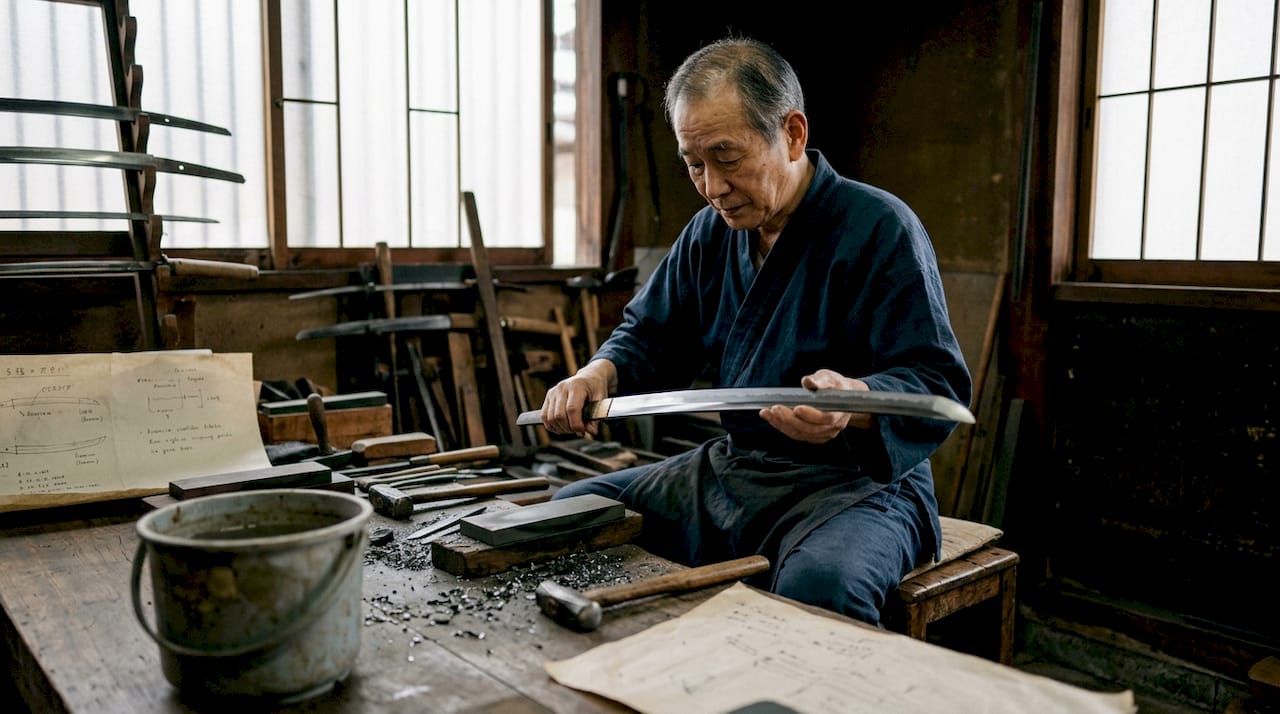
Kusanagi-no-Tsurugi is Japan’s most sacred sword and one of the three Imperial Regalia that legitimate the Emperor’s rule. Found inside the eight-headed serpent Yamata no Orochi according to the Kojiki, Japan’s oldest chronicle, the sword was drawn from the creature’s tail by the god Susanoo. It represents valor and is said to be housed at Atsuta Shrine in Nagoya, though no one outside the imperial household has reportedly seen it in centuries.
Dōjigiri Yasutsuna is the most physically accessible of the three. Forged between the 10th and 12th centuries by the smith Hoki Yasutsuna, it was used by the warrior Minamoto no Yorimitsu to slay the demon Shuten-doji. It is now a National Treasure of Japan and sits in the Tokyo National Museum, where collectors and enthusiasts can see it in person.
Key facts on Japan’s legendary swords:
- Honjo Masamune: Lost since 1945, last seen during WWII occupation
- Kusanagi: Imperial Regalia, last reportedly seen publicly in 1185
- Dōjigiri: Physical artifact, Tokyo National Museum, 10th to 12th century origin
Pro Tip: Japanese sword aesthetics have a massive presence in anime and gaming culture. Our anime swords collection includes replicas inspired directly by this tradition for display and cosplay purposes.
Ancient Asian marvel: Sword of Goujian
While Japanese and European swords dominate most legend lists, one Chinese sword deserves a starring role based on pure archaeological shock value alone.
The Sword of Goujian dates to the Spring and Autumn period of ancient China, between 475 and 221 BC, and was discovered in 1965 in a waterlogged tomb in Hubei Province. What stunned archaeologists immediately was its condition. After more than 2,000 years buried in a wet, sealed tomb, the blade was still razor sharp. The edge drew blood the moment a researcher accidentally ran a finger across it during examination. Tests showed no signs of corrosion, a remarkable feat given its age and environment.
The metallurgical explanation involves the blade’s layered construction: a high-tin bronze edge for sharpness combined with a high-copper bronze spine for flexibility. The surface was also treated with a sulfation process that created a protective layer. This was not accidental engineering; it was deliberate, sophisticated metallurgy that would not look out of place in a modern workshop.
The sword belonged to Goujian, King of Yue, who became a symbol of perseverance in Chinese culture. His story of enduring hardship and defeat before ultimately triumphing is one of the most celebrated in Chinese history, and the sword became an extension of that narrative. It now sits in the Hubei Provincial Museum, where it is one of China’s most prized cultural relics.
Key facts on the Sword of Goujian:
- Age: Approximately 2,400 to 2,500 years old
- Discovery: 1965, Hubei Province, China
- Condition: Still sharp on discovery, minimal corrosion
- Technology: Layered bronze construction with sulfation surface treatment
- Cultural meaning: Symbol of perseverance and royal power in Chinese history
| Feature | Detail |
|---|---|
| Era | 475 to 221 BC |
| Material | Layered bronze alloy |
| Discovery year | 1965 |
| Current location | Hubei Provincial Museum |
| Notable quality | Sharp after 2,400+ years |
Collectors who appreciate ancient craftsmanship often look to European sword replicas for similar aesthetic connections to antiquity.
Comparing legendary swords: Features at a glance
Having walked through individual swords, it is worth stepping back and looking at what separates them from each other and what they share.
Western swords emphasize chivalry and Christian relics: Durandal and Joyeuse both carry religious significance that tied the sword’s power to divine authority. Japanese swords like Masamune blades focus on transcendent craftsmanship and spiritual purity. The Sword of Goujian represents Chinese mastery of materials science centuries before Western metallurgy caught up. Each sword tradition reflects the values of the culture that produced it.
One striking pattern across cultures is the idea of the indestructible sword in legend, where swords like Durandal and Excalibur embody ideal warrior virtues rather than practical reality. Real swords prized for their metallurgy, like Ulfberht Viking swords made with high-carbon crucible steel, show that actual craftsmen pursued quality just as obsessively as storytellers pursued myth. Both traditions are chasing the same goal: a blade that transcends what ordinary tools can do.
For gaming and collecting purposes, the sword legends and modern blades connection is very real. Final Fantasy uses Masamune as a weapon name. Dark Souls draws on European relic sword traditions. The Legend of Zelda’s Master Sword echoes Excalibur almost beat for beat.
| Sword | Origin | Real artifact? | Craftsmanship focus | Cultural symbol |
|---|---|---|---|---|
| Joyeuse | France | Yes | Medieval European | Royal legitimacy |
| Durandal | France/Basque | Legendary | Epic poem tradition | Christian chivalry |
| Honjo Masamune | Japan | Yes (lost) | Peak Japanese swordsmithing | Shogunate power |
| Kusanagi | Japan | Debated | Divine origin | Imperial authority |
| Dōjigiri | Japan | Yes | Classical tachi forging | Warrior valor |
| Sword of Goujian | China | Yes | Advanced bronze metallurgy | Perseverance and royalty |
Viking sword replicas represent another powerful collecting tradition tied to the same impulse: owning a piece of the warrior legend.
Expert perspective: Why sword legends endure—and what collectors overlook
Here is something most sword articles will not tell you directly: the physical object often matters less than the story attached to it. The Honjo Masamune is gone, yet its reputation as the greatest sword ever forged has only grown since its disappearance. That is not a coincidence. Mystery and loss amplify legend. The sword you cannot have is always more powerful than the one you can.
Collectors sometimes make the mistake of treating craftsmanship and story as separate categories, as if you pick one or the other. The most resonant pieces in any collection combine both. A beautifully forged blade with no context is decoration. A blade with a story, even a fictional one, becomes a conversation and a connection to something larger.
Museums and gaming franchises both recognize this, which is why the Louvre displays Joyeuse at eye level and Final Fantasy named one of its most iconic weapons after Masamune. Both institutions understand that people do not just want to see or use a sword. They want to feel the weight of its story.
If you are building a collection, do not underestimate the narrative side of what you own. Know the history behind the blade style you choose. That knowledge transforms a display piece into something that actually means something, and that is worth far more than the steel alone. The best real and replica swords earn their place precisely because they connect craft to story.
Explore and collect: Real and replica swords for enthusiasts
These legendary blades prove that a sword can be far more than a weapon. At TopSwords, we have built our entire catalog around that idea.

Whether you are drawn to the chivalric tradition of European swords or the spiritual artistry of Japanese blades, you will find replicas and original designs crafted to the same obsessive standard that made the originals famous. Our custom battle sword in Damascus steel carries the same layered forging philosophy that made legendary blades remarkable for centuries. Browse our medieval sword collectibles for historically inspired pieces, or explore our anime sword replicas if gaming and pop culture legends are your entry point into this world. Every piece ships with the craftsmanship these stories deserve.
Frequently asked questions
Which sword is considered the most valuable artifact?
The Honjo Masamune is regarded as a National Treasure of Japan and symbolized shogunate power before its disappearance during WWII, making it both the most revered and most sought-after missing sword artifact in history.
Are famous swords mostly historical or legendary?
Some swords like Joyeuse and the Sword of Goujian are real artifacts with verified provenance, while others blur history and myth so completely that separating fact from story is nearly impossible.
Where can collectors see legendary swords?
Joyeuse is displayed at the Louvre in Paris, and Dōjigiri sits in the Tokyo National Museum, while swords like the Honjo Masamune and Kusanagi remain inaccessible or missing entirely.
Which sword legends influence modern gaming?
Swords like Masamune and Excalibur have directly inspired major game franchises, with Final Fantasy naming iconic weapons after them because their mythic status translates seamlessly into fantasy world-building and storytelling.